Showing posts with label Tricks. Show all posts

Wednesday, August 1, 2012

Shipping as Customer Service- a confirmation

About a week ago, I shipped out a lovely copy of Japanese Wood-Block Prints, a pretty standard order.  But, as I explained in my post "Packing Books for Shipping", I was careful to give the shipment a professional look.  I added a company bookmark, wrapped the book in paper, then packed it tightly in foam, then added a personal thank you to the packing slip.  The goal here is to present an aura of professionalism and care, since this is the only interaction we have with our customers and we desire for repeat orders.

This approach was largely philosophical, without direct evidence, until I received a message today that read:
Thank you, so much, for my book.  I am delighted with the edition of "Japanese Wood-block Prints."    I had received a copy as a gift and wanted another to give as a gift.  I was particularly impressed with your packaging.  I will look for your company in the future when I am shopping for books.  Thanks Again, [Name Erased]
Thus, I re-emphasize the point that your shipping is your primary face to the customer, your one chance to impress.

Thursday, April 26, 2012

Selling other stuff #2: Silver Coins and Bullion

In the ongoing hunt for books, you will inevitably come across other, non-book materials that might be worth your while to pick up.  Some of these are quite obvious overlaps, such as CDs, DVDs, comics and posters, but one you might not think of is silver.  I have found silver for sale in antique shops, flea markets and even, on one occasion, a pet groomers/trading card shop.  If you have a good, rough estimate on the current value of silver, you can sometimes pick up good deals that are excellent long term investments.

The primary advantages to purchasing silver are the fact that it has over the decades slowly increased in price.  It is thus safe and easily traded most anywhere.  The second is that it can be purchased in small dollar values that fit any budget.

There are two types of silver easily available: bullion and coins.  Bullion is the term for privately produced silver rounds (they look like coins but can't be called them for legal purposes) and bars.  Coins are produced by governments and include both fancy, large ones produced by modern mints and the smaller dimes, quarters, 1/2 and 1 dollars minted before 1965, when the US coinage still operated on a precious metal basis.  These are some of the easiest since they are universally recognized and have a set, easily compared weight (so a quarter has 2.5 times as much silver as a dime and a dollar has 4 times the silver of the quarter).

So, how to know what a fair price is?  Start off by checking the "spot price" for silver, either in your newspaper or on a site like CNN Money.  This will give you the price of a Troy Ounce, or $1.40 face value of pre-1965 coinage.  I have constructed a spreadsheet on OpenOffice Calc (you can use the same formulas in Microsoft Excel) where I can put in the bullion price (cell C4) and it automatically tells me the spot prices for various other values as well as what they would cost with markups of 10%, 20%, 30% and 50%.  Smart sellers always have a markup, so don't expect to get spot price most of the time.
Click for larger image
I have included the needed formulas for reproducing the spreadsheet on your home computer in red.  Column A is simply written in, as have cells B4 and B5.  The leftmost formula [ =(B5/4) ] is to calculate 25% of $1.00's face value of coinage.  Other cells would divide B5 by other rations (such as B5/10 for B9 which is $0.10 face value).  In Column C, C4 is written in as it's the bullion price, the remainder of the column is based upon a calculation [ =(C4*B5) ] this is a simple one to convert, for the next row it would be =C4*B6, and the next one =C4*B7.  The remainder of the chart helps you estimate the current markup.  The only alteration is that in Row 3 it reads =SUM(C3/10;C3) and in Row 2 its =SUM(C2/10;C2).  For other columns the alteration is in the divisor.  So for 20% the formula is =SUM(C4/5;C4) and for 30% its =SUM(C4/3;C4) [NOTE: Yes I know it's really 33%, I am rounding] and for 50% its =SUM(C4/2;C4).

If you have any questions don't hesitate to ask!

Thursday, April 5, 2012

Selling Textbooks and Bookscouter.com

There is much talk on the internet and on college campuses about the trade in textbooks,  even Obama mentions it on occasion.  I have to agree with him that it's largely a big scam which, in the end, truly profits only the textbook companies.  I had an archaeology professor who once told me that with all of his royalty checks for a specialist textbook he had authored a few years before, he could afford a six pack of beer.  He did note that it could probably be really good beer.

That aside, you will undoubtedly come across not just formal "textbooks" in your travels, but all sorts of books that are taught in classes and, therefore, bought by online textbook firms.  These are the big players: Textbooks.com, Powell's Books, Chegg, etc.  However, I never go directly to these websites.  Instead, I always start with Bookscouter, where you put in the ISBN and they automatically search 44 different companies and give you comparative prices.

There are a number of distinct advantages to dealing in textbooks:
  1. Guaranteed Profit:  If they offer you a price and you accept it, you know you'll make a profit.  These are guaranteed sales.
  2. Prepaid Shipping:  The legit companies offer shipping, all you need to do is print off the label and slap it to a box (more on strategically shipping).
  3. They're usually books you can't sell elsewhere: They are softcovers, recently written, etc.  This means you're not drawing from your carefully selected stock of beautiful old books.
There are, of course, disadvantages as well:
  1. Prices Change:  Most of these websites are seriously sneaky and are constantly changing their prices.  Hence, don't sit on the books, buy them and sell them that night in order to lock in the price.  The exception is Textbooks.com which guarantees their prices for a month.
  2. Minimum Orders:  Every one of these sites has a minimum price or number of books (usually price), below which they will not buy your books.  They don't want to ship your single copy of The Merry Wives of Windsor across the country as it cuts into their profit margin.  These minimums are different for each site and you should make note of them.
  3. General Sleaze:  The textbook companies are bottom-of-the-barrel parasites.  I don't feel particularly good about working with them.
So, how do I work this?  I generally try to get a number of these books simultaneously, sending ISBNs to a partner via textmessaging who tells me which to buy.  Then I come home and try to cobble together the best deal.  Soon, I will be posting a guide to the spreadsheet I use to help me with these calculations.  Alternatively, I look on Craigslist for people selling single textbooks that are above the minimum, I have made $30 in profit on a single book in this way before.

Make sure you check the ISBN of any book you buy.

Friday, March 30, 2012

Romance Novels are Radioactive

Anyone who touches a toe into the pool of book dealing will encounter the great, cracked-spine, worn-cover hordes of romance novels (such as the famous Harlequin line).  Don't touch them.  Here are two illustrative examples of why not:

Example #1

A few years ago, I helped a friend out in a small used book store he ran in a college town.  Generally speaking I wasn't authorized to buy books, but we did have a "buy list" of stalwarts that we always purchased, with accompanying prices.  On this list were "romance novels about cowboys (must wear cowboy hat on cover)" for 25 cents.  There was a young woman who stopped by once a week to inquire about these books and was willing to pay a hefty $1 a piece, provided the cowboy had a cowboy hat on the cover.

Example #2

Much more recently, I was collecting a wide variety of books to prepare for a flea market stand that never materialized.  On Craigslist I found an offer for a romance novel collection, which had to be bought in total for what worked out to around 5 cents a book.  They became an albatross around my neck as the box came to live in my car, accompanying me to every used book store I visited.  My library wouldn't even accept them for free for their sale.  I eventually, months later, unloaded them for about 3 cents a book on Craigslist.

Reflections

Example 1--a standing buyer willing to pay x4 the price you paid--is just about the best you can hope for.  However, my friend still only made 75 cents a book and most weeks didn't find any romance novels with cowboy hats.  While the payback was worth a minimal, passive effort, it certainly wouldn't pay his bills in the long run and was more valuable as a laugh.  The second example is actually not a worst case scenario, the worst case would be unloading the books into a bonfire, but it is far more typical of dealing with these books.  I took a hit, not just in up-front costs but also in time, gasoline and pride as every book dealer in the city came to think "oh, there's the guy who thinks he can sell Harlequin novels."
Life Lesson: Romance novels are radioactive.

PS: For all those looking for a bit of beefcake (or a laugh), here's a video on The Making of a Romance Novel Cover.

Tuesday, March 20, 2012

Making your own Book Wrapping


**Always check the shipping requirements of any website you sell through to ensure you utilize their standards**

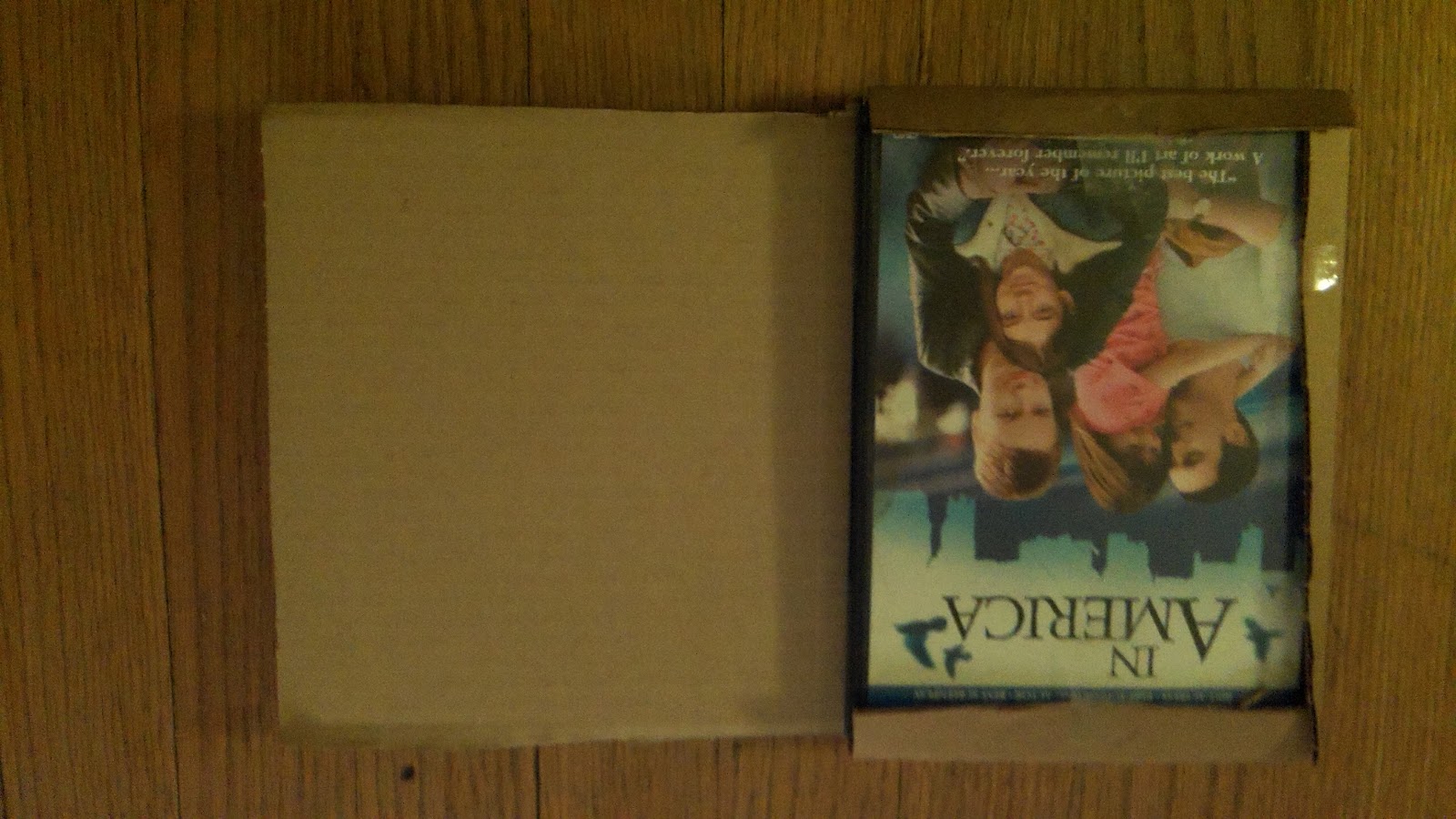
Some times, you simply don't have enough boxes, or boxes of the correct size, to ship all of your books (for more on conventional shipping, check out this post). There is an alternative manner of shipping books, which I call “wrapping” books. It involves a single large piece of cardboard, roughly 2.5x as wide as the book and 1.5x as tall.

This system of wrapping only works with tightly bound, strong books—or similar goods like DVDs in cases. Do not use it with fragile books, or those that are particularly valuable; I only use it with recently published books in excellent condition. Sometimes it helps to first wrap the book in a protective foam sheet or other protective material.

The process works like this.
  1. Lay the book or DVD out on the cardboard, roughly twice the thickness of the book from the width dimension on the right side and in the middle on the height dimension.
  2. Draw lines with a ruler along the upper, lower and right-hand sides. Make the lines a bit away from the edge of the book to give the cardboard space to be bent over.
  3. Cut out the corners as demonstrated. This creates an easily foldable flap on the right-hand side.
  4. Bend over the right hand flap—it may help to run a pen or the ruler's edge along the line to make an indentation. Replace the book and draw a line down the left-hand side of the cardboard.
  5. Cut out the top and bottom edges to create top and bottom flaps.
  6. Bend over the edges on the top, bottom and short flap. Crease the fold lines if necessary. You may want to trip the top and bottom flaps if they are particularly long.

  7. Bend over the top flap, creasing it as needed. Trim the cardboard so it does not overlap the top. Tape all of the edges.

You may wish to reinforce the corners—the weakest part of this wrapping—with an extra layer of cardboard inside.